 “Let Us Pray to the Lord”: Neither “Pray Thou, Father” nor “Pray Ye, Faithful” (Secret Prayers)
Pan. Papadimitriou, PhD
From the 3rd Greek edition, 15/5/2026
[at the end the article is given in pdf]
“while the Secret Prayer is being performed” (St. Gregory of Nyssa, 4th c.)
In this article we argue that when the deacon says “Let us pray to the Lord,” we must understand this as addressed both to the priest and to the faithful. Thus, the priest obeys and responds with his secret priestly prayer, while the faithful, also pray secretly and inwardly, chiefly with “Lord, have mercy,” while only the chanter gives the response aloud. The central thesis is that in the Divine Liturgy there are three coordinated forms of prayer: the common audible deaconal prayers through Prosphonesis, the secret priestly prayers, and the secret lay or monastic (in the monasteries) prayers. These are not competing or disconnected prayers, but one common ecclesial prayer rising to God. The prayers of all become one Prayer, one Power, by the Grace of God. The traditional silent reading of the priestly prayers, is defended, and their modern amplification through microphones is critisized, and several academic positions concerning the timing, audience, and function of the priestly prayers are challenged.
In the Church, the Master of Services is the Deacon.1 “The role of the Deacon in divine worship has been determined with great wisdom. He performs the duties of a master of services in two directions [often simultaneously]:2 toward the People and toward the Priest.”3 Naturally, in the absence of a Deacon, during a concelebration, one of the Priests undertakes (from within the Sanctuary) the Prosphonesis (Ekphonesis) of the Deacon’s prayers.
A. Three Kinds of Prayers in the Liturgy
In the Divine Liturgy we have three kinds of prayers:
a) Common 4 through Prosphonesis Prayers (ekphonetic,5 audible, spoken aloud) by the Deacon,
b) Priestly Prayers (secret6 (μυστικές), without microphones,7 with one exception),
c) Lay-Monastic Prayers 8 (likewise secret,9 just as the Priestly Prayers).
First, we have the common through Prosphonesis Prayers (ekphonetic, audible), which the Deacon, always praying and facing East,10 addresses toward the Priest and toward the Faithful People. What today we call the Deaconal petitions (Diakonika), Peace Petitions (Eirenika), Synaptai, Supplications, or Deaconal petitions/supplications, Bidding prayers, in the 4th century and earlier were called Prayer through Prosphonesis, as is attested by Canon XIX of the Council of Laodicea (364 A.D.) 11 Moreover, until relatively recently, the Diakonika were also called Prayers (before the so-called Liturgical “Renewal” monopolized the term “Prayers” exclusively for the Priestly Prayers), as may be seen, for example, in the Hierotelestikon of Vogiatsis.12 Each individual petition separately is a prayer, but a Prayer properly speaking is chiefly the entirety of the petitions together with the concluding prayer/doxology at the end.
Prosphonesis is the common exhortation, the common invitation by the Deacon to the Priest (primarily) and to the People (and to the Chanter) unto Prayer,13 by means of the common Synaptai and Supplications. The Prayers through Prosphonesis were originally very lengthy.14 And the Council of Laodicea informs us that at that time there were two Prayers through Prosphonesis of the Faithful (there were also others for the Catechumens, the Energumens, etc.).
When, in Liturgiology, we speak of Priestly Prayers of the Faithful, Priestly Prayers of the Catechumens, etc., this does not mean Priestly Prayers supposedly addressed to the Faithful, to the Catechumens, nor does it mean that these Priestly Prayers are to be heard by the Faithful, the Catechumens, etc. (as some gravely err and arbitrarily interpret them), but rather they are understood as Prayers of the Priests for the Faithful, for the Catechumens, etc.
All Prayers (Deaconal, Priestly, Lay, Monastic) are addressed to God, not to men, but are offered for men, for the Priests, for the Faithful, for the world in general, etc. This is clearly evident, for example: “For ... let us pray to the Lord,” not “For ... let us pray to the People.”
However, the common through Prosphonesis Prayers for the Faithful, for the Catechumens, which are addressed by the Deacon — these indeed must be heard primarily by the Priests, and naturally by the Faithful as well (and by the Catechumens those for the Catechumens). For this reason they are also called Prayers through Prosphonesis: so that, obeying the Deacon’s common Prosphonesis addressed to them, both the Priests and the People may respond by praying secretly (μυστικῶς), inwardly (κατὰ διάνοιαν), each with their respective prayers.
This is also supported by Canon XIX of the Council of Laodicea (364 A.D.):15 “the first [Prayer for the Faithful] silently/secretly (διὰ σιωπῆς, σιωπηρῶς),” 16 and by St. Gregory of Nyssa (+394 A.D.): “while the Secret Prayer is being performed,” and by Saint John Chrysostom (+407), among others, as we shall see below.
The common through Prosphonesis Prayers always were and are pronounced audibly (ἐκφώνως), by the Deacon; and the Priest, responding, was praying and prays simultaneously and secretly (μυστικῶς) as well; and the faithful People, parallel with the Priest, likewise were praying and pray secretly, inwardly (κατὰ διάνοιαν) [PG 1, 1076–1077],17 saying chiefly “Lord, have mercy,” or as God then illumined and illumines each one (and according to each person’s prayerful strength, by the grace of God).18 Only the Chanters say “Lord, have mercy” audibly.
That is to say, in the Divine Liturgy, as obedience and response to the common through Prosphonesis Prayers by the Deacon, we have the other two kinds of Prayers which we mentioned: the Priestly secret (μυστικές) Prayers of the Priest, and the secret Prayers of the faithful People (and of the Monks, Elders19).
B. “Let Us Pray to the Lord”: Neither “Pray Thou, Father” nor “Pray Ye, Faithful”
We must understand, must clearly comprehend, that:
When the Deacon makes the Prosphonesis, he does not say: “In peace, pray thou to the Lord, Father! And you, faithful People, listen to the Father praying audibly (ἐκφώνως)!”
Nor does he say:
“In peace, pray ye to the Lord, faithful!”
But what does he proclaim?
He proclaims:
“In peace let us pray to the Lord!”
To whom does the Deacon say the “let us pray”? Naturally, to the Priest and to the faithful People.
According to Saint John Chrysostom (+407 A.D.), he says it first of all to the Priest, that he may begin to pray — naturally secretly (μυστικῶς) — with his Priestly Prayer; and to the People, that they may likewise begin, in parallel/simultaneously, to pray secretly as well with “Lord, have mercy” (only the Chanter says “Lord, have mercy” audibly), or with each own secret Prayer:
“For the ‘Let us pray’ is spoken not only to the Priests, but also to the People.” [PG 61, 399].20
“This ‘let us pray,’ just as also the ‘let us stand aright’ which we hear in the Church, is not addressed only to the Priests, but also to the Congregation, the People.”21
And grammatically as well, the “let us pray” is a common summons to prayer both to the Priest and to the faithful People.
For this reason Saint John Chrysostom also distinguishes the Prayers of the People from the Prayers of the Priests:
“You deceive yourself, O man; for it is indeed possible to pray at home, but it is impossible to pray there in the same manner as in the Church, where there is such a multitude of Fathers, where a cry is sent up to God with one accord. You are not heard in the same way when beseeching the Master by yourself, as when doing so together with your brethren. For here [in the Church] there is something more: namely concord and harmony, the bond of love, and the prayers of the Priests. For this reason the priests preside, so that the weaker prayers of the multitude [People], taking hold of these stronger ones, may together ascend with them into heaven.” 22
What is this “cry to God with one accord” of which the Saint speaks? It is Power! The simultaneous, parallel silent/secret Prayers of all — both of the Priest and of the People — do not ascend separately to God, but become one secret cry,23 one Power, one Prayer of all, which ascends to God.
The same experience that Saint John Chrysostom had, Saint Porphyrios of Kavsokalyvia also had outside the Divine Liturgy, and he explained it to us concerning the collective prayer of the spiritual children of the blessed Metropolitan Augustine Kantiotes of Florina:
“I was deeply moved on that day when I saw the people weeping. Thousands of souls praying all together. One power. [...]. Oh, oh... One concentrated power. I do not know how to express it. Power. I cannot even call it atomic [nuclear (energy)]. Something higher. Something great. [...]. All were praying. Souls, thousands of souls. People... [...]. For do not look merely at yourselves... You yourselves may not have prayed so intensely. Yet within the multitude — and among the thousands whom I saw — there were souls that had carried the others along with them in prayer. It had become one prayer, one power of all. The prayer of all had become one power. And the great ones were praying, and the little ones were entering into the great ones. One power!”24
How was this multitude praying? Was one person praying aloud, while the others were listening to him? Certainly not. All were praying together, yet also secretly — that is, inwardly. Yet although all were praying together, and some were praying more fervently than the others, these were not separate prayers, but had become one Prayer, one power of all, ascending to God!
Of course, “it is not simply the great number of those praying together that gives power to prayer, but the addition of their virtue to it [to the prayer].” That is, “the prayer of the multitude has great power when virtue also coexists with it.”25
C. The Common Prayer in the Liturgy
The Faithful in his common prayer during the Liturgy is represented neither by the Priest nor by the Chanter,26 but rather his prayer27 is “assisted/strengthened” (in a secret manner, by the Grace of God), within the bond of love toward one another, chiefly by the silent/secret prayer of the Priest, the audible prayer of the Chanter, and also by the silent/ secret prayer of other Faithful who possess either greater or even lesser virtue28 than himself (see also the experience of Saint Porphyrios, and Saint John Chrysostom, in section §B).
The People are neither passive spectators nor passive listeners to the Priest29 or to the Chanter, nor do they parrot (echo aloud)30 the secret Prayers of the Priests in the common Prayer of the Church by reading from the modernistic “Hieratikon for the faithful” books, which are wrongly used during the Services.
Common Prayer in the Liturgy means Prayer in common, that is, praying together, jointly, each responding — both the Priests and the People31 — by praying secretly at the common (for the Priests and the People) through Prosphonesis Prayers of the Deacon (see above [PG 48, 725]); and the prayers of all become one Prayer, one Power!32
D. Related Liturgical Errors of Ioannis Fountoulis 33
The following are related liturgical errors of the late Ioannis Fountoulis:
1. As we saw and analyzed in our previous articles [ΠΠ7, ΠΠ13, ΠΠ14], he unfortunately rejected the most ancient and, up to our own days, living Orthodox sacred tradition saying: “while the Deacon is offering the Prayer, the Priest also prays the Prayer,” which is in fact founded upon the most ancient extant manuscript tradition, and upon Saint John Chrysostom.34
Indeed, not only did he reject this most ancient Sacred Tradition of the Church — which is also recorded in the oldest surviving Constantinopolitan episcopal Euchologion manuscript (B 336, late 8th century) — but he even regarded it (more correctly: slandered it) as a corruption of Tradition35 (!) — although Chrysostom himself mentions it 400 years earlier than B 336 [PG 61, 399] — evidently in order to support his theory through the method of petitio principii (“assuming the conclusion”).
2. He erred to the point of writing that: “The praying Priest, in a certain manner, became detached and independent (sic) from the worshipping community, since during the Deaconal petitions — or [at times, in the absence of a Deacon] during the chanting of the antiphons and the Trisagion — he reads the prayers”! 36
Yet the Fathers appointed the Deacon to command him: “Let us pray to the Lord (Father)!” (!), and the Priest himself, first of all, must obey and respond by likewise praying secretly to the Lord, just as the People also do.
The common Prayer (see §C) does not render independent, but unites (see also the experience of Saint Porphyrios, and Saint John Chrysostom, in §Β). Cf. [ΠΠ13]. 37
3. He erroneously considers (as do also very many Bishops, Presbyters, Theologians, and Liturgiologists who have been led astray) that the Synaptai (the Deaconal petitions) are supposedly addressed38 only to the faithful People,39 essentially repeating the error of his teacher Trembelas and of their era.40
4. He arbitrarily considers that the Deaconal petitions supposedly “introduce” the Prayer of the Priest.41, 42, 43 Since the secret Prayer of the Priest is the required “response” to the Prayer through Prosphonesis (and summons to prayer) of the Deacon, it is entirely natural and logical that there should be a similarity of subject matter.
5. He erroneously considers, as a consequence of #4, that the Prayer of the Priest is said temporally after the Prayer through Prosphonesis of the Deacon, and not in parallel, as the living liturgical tradition and the ancient manuscript tradition have it.44
6. He considers that the supposedly correct and original position of the Priestly Prayers (whether with or without a Deacon or another Priest) is precisely before each Ekphonesis, which is contrary to the living Sacred Tradition, and also contrary to the majority (and ancient) manuscript liturgical Tradition.45, 46
This error,47, 48 unfortunately, swept into the modern Hieratikon of the Apostoliki Diakonia (see ftn. 33) already from 1962; yet Tradition, it seems, was still strong and had not yet been greatly altered through the various modernistic liturgical editions.
Indeed, because of the confusion which this change in the Hieratika evidently caused among the traditional Priests who celebrate alone, they were later compelled (1977) to admit and record the Tradition that:
“If the Priest celebrates alone, the following Prayer, as also the others, he says always secretly (μυστικῶς) after the Ekphonesis, while the Choir chants the corresponding hymns” (Hieratikon of Apostoliki Diakonia, 1977/2000, p. 106; see also Hieratikon of the Ecumenical Patriarchate 1895, Hieratikon of Apostoliki Diakonia, 1951).
If the Chanter finishes first (who at those points should “lengthen” the response somewhat — or even repeat it — when there is only one Priest; for this reason, in the Liturgy of Saint Basil, because of the more extensive Priestly Prayers, the Liturgical responses of the Chanter are likewise more extensive), there occasionally prevails in the Church a liturgical prayerful silence until the Priest also finishes his secret (μυστική) Prayer.49
This innovation concerning the position of the Priestly Prayer — namely, the temporal transposition of the Priestly Prayer to precisely before the Ekphonesis (whether with or without a Deacon or another Priest) — may, however, be seen earlier, for example, in the Prayers of the Antiphons50 by Archimandrite Seraphim Papakostas (1892–1954), head of “ΖΩΗ” (who had already been led astray by Trembelas concerning the Secret Prayers),51 from whom Fountoulis evidently also adopted positions.
Nevertheless, even in 1953, within “ΖΩΗ” itself, there were recorded different positions concerning the Priestly Prayers: one of Fr. Seraphim Papakostas as mentioned above, and a second (and more ancient) one of D. G. Panagiotopoulos:
“While the First Antiphon is being chanted, the Priest says within the Sanctuary the following first Prayer of the Antiphons,” 52 (cf. the Hieratika of 1895, 1951, 1977/2000, as mentioned above).
Trembelas himself also admitted (regarding the Prayers of the Antiphons) that: “each prayer was most probably read, as also today, during the course of the Synapte.” 53
7. As though he had been influenced by the sound-engineering of radio productions54 (Fountoulis gave radio broadcasts), he tells Priests (to):
“They read the Prayer in a lower tone [apparently he is unconcerned55 about the confusion/noise which the faithful hear from the loudspeakers even with the lower tone ...through a microphone], and raise their voice somewhat when the Chanter finishes,56 so that a pause/gap (Chasmodia)57 may not be created [that is, he equates the liturgical prayerful silence of the Church with the pauses of musical or theatrical performances] and so that the words of the [secret] Prayer [of the Priest] may be heard.” 58
Unfortunately, this is also what many Priests and Bishops do today, having been led astray in ignorance (especially in the Liturgy of Saint Basil).
A single minute of preaching is enough for the faithful People to learn (and understand) that in the Liturgy there are at times also moments of liturgical prayerful silence, wherein both the Priest and the People continue praying secretly. See ftn 49.
However, the position of the Priestly Prayer, even in the most ancient manuscripts, is given in the midst of the Prayer through Prosphonesis, before the Antilavou (“Help us”); yet even this position is conventional, and not scholastically ordered. 59
Strictly speaking, the Priest begins to pray secretly with his Priestly Prayer — just as the faithful People simultaneously/in parallel also begin with their own secret Prayer — when they hear the Deacon (or the other Priest, in a Concelebration, who has undertaken the ekphonesis of the through Prosphonesis Prayers) exhorting them to prayer with the words “let us pray.”
If the Priest finishes his secret Prayer earlier than the common Prayer of the Deacon, naturally the Priest may continue praying secretly (whether with “Lord, have mercy,” or with the “Jesus Prayer,” or spontaneously, as God illumines him, according to the command “pray without ceasing”).
If the Deacon finishes his common Prayer (and the Chanter the final response), and the Priest has not yet finished his own secret Prayer, naturally there follows in the Church a liturgical prayerful silence, wherein all pray in silence (ftn 49).
E. The Secret Prayers, a Tradition from Ancient Times
The silent/secret character of Prayer has been established by Christ Himself, Matthew 6:5–6.60 A few Priestly Prayers alone have exceptionally been instituted aloud in our Sacred Tradition, perhaps because of a catechetical character or for other historical reasons unknown to us thus far.
In the Divine Liturgy, the only audible Priestly Prayer is the Prayer Behind the Ambo (Opistambonos); for this reason it was said behind the Ambo, that is, in the center of the Church, so as to be heard by the faithful (being closer to them). Naturally, the Priest said it while praying facing East.61
This (Opisthambonos) Priestly Prayer was added later by the Holy Fathers for the sake of the curious gnosimachountes (those who insist on knowing everything), who wanted to know what the Clergy were saying secretly (or whispering), of course without microphones, within the Sanctuary, according to Saint Germanos, Patriarch of Constantinople (640–740).62, 63, 64
The secret manner of the Prayers is also supported by the ancient manuscripts (up to the recent Hieratika of the Apostoliki Diakonia before approximately 2002–2004), which contain the explanatory rubric: “while the Deacon is offering the Prayer, the Priest also prays the Prayer,” or even simply: “secretly.” 65
That is, while the Deacon offers aloud the common through Prosphonesis Prayer (the Deaconal petitions), the People also, responding in obedience, pray secretly; but first and simultaneously the Priest also prays secretly with his Priestly Prayer, addressing it to God, and “conversing alone with Him” («συλλαλὼν μόνος Αὐτῷ»).66, 67
The Priest “conversing alone with God” — for this reason there also existed the Curtain (Katapetasma) of the Sanctuary (which later evolved to the solid Iconostasis)68 and the Holy Doors; for this reason also there was the Ciborium of the Holy Table with its curtains69 (Matthew 6:5–6), which closed, creating a Closet of Prayer for the Priest.
Ioannis Fountoulis (1927–2007), however, to his credit, honestly mentions the prevailing order in the Church during his own days (which he himself evidently and unfortunately struggled — together with other lesser-known so-called liturgical “renewalists” — to overturn, probably in ignorance, resulting in the present indescribable situation,70 at which even he himself would be alarmed71 ) :
a) “A tradition extending over many centuries72 has, however, been formed concerning the secret reading of the Prayers, and this today is the generally prevailing order throughout the entire Orthodox Church.” 73
b) “Quite early there prevailed the practice that the prayers of the Divine Liturgy be said secretly (μυστικῶς). Usually the priest said them at the time when the deacon was saying the synapte, in any case before the ekphonesis.” 74
c) “Secretly, as is well known, all the Prayers of the Divine Liturgy are said today, except for the Prayer Behind the Ambo [at the end].” 75
d) “Secretly are said the Prayers which are addressed to God.” 76 [Yet all Prayers are addressed to God (!), not to men, but for men, for the world, etc.].
We have supported from the Tradition that, obeying the common through Prosphonesis Prayer of the Deacon (“Let us pray to the Lord”), both the Priests and the People, as well as the Elders and Monks in the Holy Monasteries and Sketes, respond by praying secretly (only the Chanter audibly).
Consequently, the Priestly Prayers of the Liturgy are necessarily silent/secret (or at least truly low-voiced — that is, low-voiced and without microphones — not within the hearing of the People):77 first, out of obedience to the word of the Lord (Matt. 6:5–6, ftn 60); out of obedience to the Sacred Tradition of the Church; also for the concentration of the Priest in Prayer (with all that this entails); 78 for the avoidance of confusion/noise; and so that the Faithful (and also the Monks and Elders in the monasteries, ftn 19) may not be distracted in their likewise secret Prayer.
Have you ever seen in the Orthodox Church a Faithful person or a Monk praying within the hearing of the one beside him or of the Priest? 79
For this reason also Saint Joseph the Hesychast thundered to the Hieromonk:
“Do not shout [the Priestly Prayers], Father; say them quietly, as it is stated in the Hieratikon, namely that they are said secretly (μυστικῶς).” 80
The silent/secret character of the Prayer of the Priests — as also of the People and of the Monks — besides all that has been mentioned in this article (and in the numerous patristic and canonical references throughout our various articles [PP{1–10, 13–14, 22}]), is also supported by the common prayerful orientation (toward the East) of the Priest together with the People, and of the Faithful among themselves.81
It is likewise supported by the traditional and ancient closing of the Holy Doors and the Curtain during the Holy Anaphora, from immediately after the Great Entrance until “With the fear [of God]...,” 82 which closing was opposed by the liturgical renewalists of the previous century even more fiercely than the eastward orientation of the Priest during the Memorial Service.83
Moreover, according to our research thus far, the earliest recorded use of the term “Secret Prayers,” referring to the Priestly Prayers of the Liturgy, is found in Saint Gregory of Nyssa (4th century), a contemporary of the Holy Fathers of the Holy Council of Laodicea, and brother of Saint Basil the Great. In his Second Canon (though concerning another matter), he makes reference to a silent/secret Priestly Prayer:
“for he is never deemed worthy to worship God together with the people while the Secret Prayer is being performed.” 84
The interpretation of Zonaras (12th century) at the disputed point reads:
“nor even to stand together with the Orthodox, and pray with them while the secret Prayer is being performed, that is, when the Priest by himself [καθ’ ἑαυτόν, inwardly, secretly] prays for the Bread to be sanctified and the Chalice likewise.” 85
Certainly, the term “Secret Prayer,” referring to the Priestly Prayers of the Divine Liturgy, must have existed prior to Saint Gregory of Nyssa (see also ftn 67), in our opinion descriptively/periphrastically even back to the Holy Apostles. 86
“As the Church has received [in the Sacred Tradition],” says the Synodikon of Orthodoxy. 87,88, 89
Amen.
Footnotes
1 The Fathers appointed the humble (we hope) Deacon as Master of Ceremonies in divine worship, so that the Presbyters and Bishops might not exalt themselves.
2 The text within brackets is our own addition/explanation.
3 I. M. Fountoulis, Answers to Liturgical Questions, Vol. IV, Apostoliki Diakonia, 1994, #482, p. 263.
4 Common, both for the Priests and for the Faithful.
5 Because in recent years some have attempted to alter the meaning of words, so as through the method of petitio principii to “prove” their theory, ekphonos means loud-voiced; ekphoneō = to cry out strongly, to exclaim loudly, according to the lexicon of P. Ch. Dorbarakis.
According to the lexicon of Evangelinos Apostolides (Sophocles), in liturgical usage, ekphoneō = “to say aloud, of certain expressions said aloud by the priest,” that is, “I speak loudly, audibly” [E. A. Sophocles, Greek Lexicon, New York, 1900, p. 446].
6 Secret Prayers (Mystikai Euchai): the priestly prayers said silently, not within the hearing of the people; for, as this article will show, the people also pray silently in parallel, while both priests and people obeying and responding to the Deacon’s prosphonesis, “Let us pray”, and prayer is chiefly silent).
7 Until a few decades ago there was no electricity (and therefore neither microphones nor loudspeakers) throughout Greece. Electric power first came to Greece in 1889 in order to illuminate the royal palace, and by 1929 only 250 towns up to 5,000 inhabitants had been electrified. In churches generally, obviously — as also in the villages — it arrived much later. In 1950, only 50% of the country’s population had access to electricity. A microphone makes even a whisper loud.
8 In Holy Monasteries: Prayers of the Monks and of the Elders (Joseph the Hesychast, Paisios the Athonite, etc.).
9 Only the Chanter audibly (ἐκφώνως), as we shall see below.
10 Pan. Papadimitriou, “The Priest Has Always Performed the Reading of the Prayers Facing East,” Orthodoxos Typos, issues nos. 2549–2550, 4/7/2025 – 11/7/2025.
11 Pan. Papadimitriou, “Canon XIX of the Council of Laodicea (364), and the Reading of the Liturgical Prayers,” 3/4/2022.
12 “‘Let us complete our supplication to the Lord [...]. [...] while the above Prayers are being said, the Priest says secretly the Prayer,’” see Hierotelestikon Teuchos (The Divine Liturgy), approved by the Holy Synod, interpreted by Archimandrite Hieronymos Vogiatsis, Andreas V. Paschas ed., 7th ed., 1923, p. 116.
13 Evangelinus Apostolides Sophocles, A Glossary of Later and Byzantine Greek, London 1860, σ. 495. —Memoirs of the American Academy of Arts and Sciences, Vol. VII, 1860, σ. 495.
14 Pan. Papadimitriou, “Prayer through Prosphonesis (Deaconal Petitions),” 5/12/2022.
15 “The holy and local Council convened in Laodicea, the Metropolis of Phrygia Pacatiana, took place, according to most authorities, in the year 364. Many Fathers, assembling therein from various provinces of the Diocese of Asia, issued the present Canons, since they were necessary for the good order and constitution of the Church. These Canons are confirmed in a general manner by Canon I of the Fourth Ecumenical Council (451) and Canon I of the Seventh (787), and specifically by Canon II of the Sixth Ecumenical Council (680); and through this confirmation they acquire, in a certain manner, ecumenical authority” (Pedalion, Athens, 1886, p. 342).
16 The “liturgical” chronological extent of this Sacred Canon, on the basis of the Holy Councils that confirmed it, is at least from (earlier than) 364 A.D. until 787 A.D. and later, and certainly corresponds to the ecumenical liturgical practice of the Church, at least within this chronological span, but also down to our own days because of its ecumenical authority (even by reason of its indirect recording in the official Hieratika of the Church of Greece up to year 2002/2004 (secretly, “μυστικῶς”), and also because of its indirect confirmations by the Holy Synods of the Church of Greece (499/1951, 1353/1956, 1137/1974) concerning the “Secret Prayers”).
17 “And let all the faithful pray inwardly (kata dianoian, κατὰ διάνοιαν, in the mind) for them, saying: ‘Lord, have mercy.’” [PG 1, 1076–1077].
Holy Apostles: “while all the people stand and pray quietly.” [PG 1, 737].
Saint Clement: “Therefore we also, having gathered together in concord unto the same place, let us cry earnestly to Him as with one mouth in conscience, that we may become partakers of His great and glorious promises.” [PG 1, 277].
— Furthermore, see in our article on Canon XIX of the Council of Laodicea, footnotes 11 and 15, concerning the phrase kata dianoian (in the mind).
18 Saint Nicholas Cabasilas: “that each one may ask privately those things which he seeks.” [PG 150, 401].
19 Pan. Papadimitriou, “Contemporary (Holy) Elders and the Secret Prayers,” 8/2/2022; Orthodoxos Typos, 13/1/2023–27/1/2023, issues nos. 2431–2433.
20 Pan. Papadimitriou, “The Deacon Says the ‘Let Us Pray’ First for the Priest, and Naturally for the People — ‘For the “Let Us Pray” Is Spoken Not Only to the Priests, but Also to Those Joining with the People,’ Saint John Chrysostom,” 1st ed., 22/7/2024.
21 Panagiotis G. Stamos, John Chrysostom — Prayer: The All-Powerful Weapon of the Faithful, Athens, 1988, p. 34.
22 [PG 48, 725].
23 “Thus also Moses was praying; wherefore, although he uttered nothing, God says: ‘Why do you cry out to Me?’ For men hear only this [externalized] voice, but God, even before this, hears those who cry out inwardly. [...]” — Saint John Chrysostom [PG 54, 646].
24 Saint Porphyrios of Kavsokalyvia, I Shall Tell You... (Recorded Narratives of the Saint Concerning His Life), Holy Women’s Hesychasterion “The Transfiguration of the Savior,” Milesi, 2015, pp. 470–472.
25 Panagiotis G. Stamos, John Chrysostom — Prayer..., op. cit., pp. 32–33. See [PG 61, 398].
26 The Chanter is, in a certain manner, the guide of the Faithful in the prayerful responses to the Prayer of the Deacon. For the negligent, he serves as their reminder and supplementation in the common Prayer; and for those who are praying, he is their guide and fellow-prayer.
In order for the Faithful to bear spiritual fruit in the Church, he himself must also pray secretly, inwardly, and not rest content thinking that the Chanter is his mouth or his ...representative. For this reason we go to Church for years and yet do not see significant spiritual progress.
Of course, for prayer to have power and bear fruit, virtue must also coexist within the faithful person (or at least some struggle for virtue, and above all repentance for our sins).
27 If the Faithful person does not pray? Then, in his ignorance, he is more likely a Catechumen.
28 Does the silent/secret “Lord, have mercy” (or “Lord Jesus Christ, have mercy upon us,” etc.) of one faithful person have the same power as that of another faithful person, or of a grandmother, or of a monk, or as the “Lord, have mercy” of Elder Porphyrios, Elder Paisios, Elder Joseph, Elder Ephraim, Elder Ephraim, Elder Stephanos — if we were to suppose that at some moment they were praying together with us in our parish?
And yet, although they do not possess the same power, our own humble and least secret “Lord, have mercy,” together with the stronger ones — and above all with the secret Prayer of the Priests — ascends to God as one great Power!
29 Today, certain Clergymen/Theologians, instead of leaving the People in peace to pray, applaud and promote the satisfying of the People’s curiosity and the continual drawing of the People’s attention toward themselves (Priestly Prayers aloud through loudspeakers, modernistic “All together,” various exhortations unrelated to the order of the Liturgy, celebrating the Liturgy on the Solea, celebrating the Liturgy facing West - contrary to the Apostolic Sacred Church Tradition), presenting these things supposedly as “participation of the People.”
30 A sign of pride is the quiet chanting and murmuring in the Church, whereby we do not allow (nor even care whether we allow) the faithful person beside us to pray, so that we ourselves may be heard (an exception, of course, is when it happens spontaneously, when it simply “slips out” once or twice).
Let us return home after the Liturgy and chant as much as we wish (there are so many byzantine chants on YouTube with which we may chant along), or do we need people to see and hear us in order for us to chant?
31 Prayer of the faithful People is not only the secret (inward, interior, without external voice) “Lord, have mercy” (the Chanter audibly), as a response to the Prayers through Prosphonesis proclaimed by the Deacon (or, in his absence, by the Priest).
Prayer is not only attentiveness to and listening to the hymns being chanted, nor only the secret response (the Chanter audibly) to the exhortations of the Deacon or the Priest.
Prayer is not only the silent/secret “Our Father” or “I Believe” (the Chanter audibly).
Prayer is not only silent thanksgiving to God.
Prayer is not only each person’s secret petitions to God.
Prayer is not only the secret Prayers to God for our family, our neighbor, the Clergy, the Chanters, those assembled in church, the sick, the poor, and all those in need, our friends, our enemies, our homeland, the whole world.
It is all these things and many others besides, by the Grace of God.
Prayer, as regards its quality, is “the communion and union of man with God” (Ladder of Saint John of Sinai, Ch. 28).
32 Likewise also the silent, secret recitation of the Creed and of the “Our Father” by each one of the Faithful, according to the Hieratikon of the Apostoliki Diakonia 1951, p. 85:
“The presiding Bishop, or the chief among the Clergy, distinctly and clearly, and each one of those assembled in church privately by himself [that is, secretly], recites the holy Symbol of Faith.” The same is also stated concerning the “Our Father,” p. 93.
33 Our reference to persons and organizations is made for the recording of the historical elements pertaining to the present article, and is not made in order to judge or generally nullify their work.
34 Pan. Papadimitriou, “The Deacon Says the ‘Let Us Pray’ First for the Priest, ...,” op. cit.
35 I. Fountoulis, Answers to Liturgical Questions, Vol. IV, Apostoliki Diakonia, 1994, #410, p. 29.
36 I. Fountoulis, Answers to Liturgical Questions, Vol. V, Apostoliki Diakonia, 2003, #551–553, p. 200.
37 Pan. Papadimitriou, “Prayers for the Catechumens (Prayer through Prosphonesis, Synapte): How Many Pray in Parallel and Simultaneously? References of Saint John Chrysostom, and Concerning Prayer in the Liturgy,” 1st ed., 22/7/2024.
38 The Prayers through Prosphonesis of the Deacon are not addressed to, but are proclaimed toward, the Priest and the Faithful. And these Prayers also, just like the Priestly and the Lay-Monastic Prayers, are addressed to God; for this reason the Deacon says, “Let us pray to the Lord,” not “Let us pray to the People” (see p. 3).
39 Error: “The deaconal petitions are addressed to the praying community” [is not the Priest himself also a member of the praying community?], Ioannis M. Fountoulis, Answers to Liturgical Questions, Vol. V, 1st ed., Apostoliki Diakonia, 2003, #558, pp. 222–223.
40 Panagiotis Trembelas:
“But in the Divine Liturgy the participation of the people is manifested even unto the present day in a conspicuous and impressive manner. The role reserved in our worship for the deacon has rightly been emphasized by liturgiologists. The litanies of peace, the petitions, the synaptai in general, chanted in melodic recitation by the deacon standing in the midst of the church, or by the priest replacing him, are invitations to the people, that they may pray to the Lord or ask from Him a particular petition. And the people respond to these invitations [silently, secretly; only the Chanter audibly] with the ‘Lord, have mercy,’ or the ‘Grant this, O Lord,’ or the ‘To Thee, O Lord.’ The whole fullness there joins itself together through common supplication and harmonious participation [yet the Priest also belongs to the fullness, and he too prays in parallel with his secret Priestly Prayer, as Saint John Chrysostom also says],” from his article bearing the somewhat strange title: “The Concelebration of Clergy and People in Worship,” Ekklesia, 1 Sept. 1949, no. 18, p. 288.
It should be noted that, more correctly from an Orthodox standpoint, the title of the article ought to be: “The Common Prayer of Clergy and People in Worship.”
There is no “concelebration of clergy and people” in worship among the Fathers of the Church or in Orthodoxy, and this term is a major error of Trembelas. We encountered this term in Greek for the first time in Trembelas.
For there to exist a “concelebration of clergy and people” in worship, there must first also exist a “celebration/sacramental ministry of the people”!
This does not exist in Orthodox.
What does the faithful person sacramentally minister in the Mysteries such that he could also concelebrate together with the Priests?
The faithful person cannot even touch and carry the Holy Gifts even half a meter during the Great Entrance (since he does not possess the Priesthood), and yet Trembelas also made him concelebrate?
The People pray together (participating through their silent/secret prayer, just as the Priest also prays secretly); they do not concelebrate.
For more on this, see Metropolitan Hierotheos of Nafpaktos, “The ‘Royal Priesthood’ and the Priesthood,” in: Translations – Mysteries and Asceticism, Holy Monastery of the Nativity of the Theotokos, 2011, pp. 101–148.
See also: “But the ‘beholding with one’s own eyes the face of the Holy Anaphora’ was and remains the fearful and sacred privilege of the celebrant, of the one ‘clothed with the grace of the priesthood,’” Ioannis M. Fountoulis, Liturgical Topics I, “The Sacramental Life of the Church and the Mass Media,” Apostoliki Diakonia, 1st ed. 2002, pp. 209–224;
and also in: Encyclical of the Permanent Holy Synod of the Church of Greece, 2792/30-6-2004:
“The Sacramental Life of the Church and the Radio-Television Media.”
41 I. Fountoulis, Answers to Liturgical Questions, Vol. III, Apostoliki Diakonia, 2002, #311, p. 26.
42 I. Fountoulis, Answers to Liturgical Questions, Vol. IV, op. cit., #410, p. 28.
43 I. Fountoulis, Answers to Liturgical Questions, Vol. V, Apostoliki Diakonia, 2003, #571, pp. 282, 284.
44 Pan. Papadimitriou, “The Deacon Says the ‘Let Us Pray’ First for the Priest, ...,” op. cit.
45 Likewise cf.: “And after the divinely-speaking Apostles, certain of the holy Fathers each composed individually prayers, and ekphoneseis, and an ordered rite of sacred celebration; such as the illustrious Epiphanios among the saints, the great Basil, and the divine Chrysostom,” [Nicholas and] Theodore, Bishop of Andida (1055–1063), [PG 140, 460].
46 “Generally, the Prayers are always placed before the Antilavou” (Sinai ms. 973 of the year 1153, Sinai ms. 1036 of the 12th–13th century, National Library of Greece ms. 713 of the 12th century, etc., and centuries earlier Barb. Gr. 336 of the 8th century indirectly yet clearly, see [ΠΠ7], and also Isidoros Pyromalles — Order of the Divine Liturgy of the Great Church (11th–12th century), Euchologion Goar (1647), p. 180);
“quite a few manuscripts place the first three Prayers after the ekphonesis [evidently in a Liturgy without a Deacon or concelebrating Priest]” (unfortunately the Vatopaidi edition does not identify/list these manuscripts);
“there are few manuscripts which place the Prayer precisely before the ekphonesis” [but even this requires examination, as for example the Euchologion Paris Coislin gr. 367 (PCS367), dated 1276–1325 (with deacon), which seemingly places the Prayer of the First Antiphon after the Synapte and immediately before the ekphonesis, but places the other two, the Second and Third, before the Synaptai (and before the Antilavou) and the ekphoneseis; and if one inserts the missing rubrics, one discovers that even in this manuscript essentially the Prayers are before the Antilavou! As we have emphasized, the position of the Prayers in the manuscripts is conventional and not scholastically ordered],
in: Divine Liturgy, Holy Great Monastery of Vatopaidi, 2020, Brief Comments, p. 91.
47 I. Fountoulis, Answers to Liturgical Questions, Vol. IV, op. cit., #410, p. 30.
48 I. Fountoulis, Answers to Liturgical Questions, Vol. V, Apostoliki Diakonia, 2003, #551–553, p. 202.
49 Listen to Saint Porphyrios, in: “Contemporary (Holy) Elders and the Secret Prayers,” 8/2/2022; Orthodoxos Typos, 13/1/2023–27/1/2023, issues nos. 2431–2433.
50 Archim. Seraphim Papakostas, Handbook of the Divine Liturgy, 5th ed., Brotherhood of Theologians “ZOE,” Athens, 1950, p. 40.
51 Pan. Papadimitriou, “The Latin-originated Innovations in the Divine Liturgy and Worship,” Orthodoxos Typos, issues nos. 2537–2541, 4/4/2025 – 9/5/2025.
52 D. G. Panagiotopoulos, Interpretation of the Divine Liturgy, “ZOE,” Athens, 1953, p. 64.
53 Pan. N. Trembelas, The Three Liturgies — According to the Codices in Athens, Soter ed., 1997, p. 27.
54 When someone hosts a program on a Radio Station, especially when he also controls the sound console, he knows that when he is about to speak he must lower the volume of the music in order to be heard, and then, when he finishes speaking, he knows that he must raise the volume of the music again. The underlined statement is similar to what Fountoulis says: that when the Chanter finishes, the Priest should raise the volume of his voice.
55 Just as, unfortunately, many Priests are likewise unconcerned about this. The solution is not to modernize, to cast aside the Sacred Tradition, and to wait for the Chanter to finish in order then to shout the Prayers, but rather to say them secretly, without a microphone (or with the microphone turned off), not within the hearing of the People (and the People likewise pray secretly, not within the hearing of the one beside them, nor within the hearing of the Priest), as the Sacred Tradition requires.
56 Others, contemporary with or later than Fountoulis, wait for the Chanter to finish before beginning to read the Prayer aloud, in violation of the Orthodox Liturgical Tradition which we have set forth. See also the Encyclical of the Holy Synod of the Church of Greece, protocol no. 1137/13-3-1974:
“According to information responsibly brought to the attention of the Holy Synod of the Hierarchy, certain clergymen, disregarding the indications in the relevant liturgical books concerning the silent/secret reading by them of the prayers both of the Divine Liturgy and of the other Sacred Services, proceed to read them within the hearing of the congregation, often waiting for the cessation of the hymns being chanted before beginning to read them, thus displaying contempt toward Ecclesiastical order and tradition and contributing to the creation of an impermissible diversity in the performance of their duties in Divine Worship.”
Were the disobedient corrected? By no means.
Unfortunately, microphones have done and continue to do great harm to the Orthodox celebration of the Divine Liturgy. The silent or low-voiced character of the Priestly Prayers — which at times are heard only by the concelebrating Priests (some Priests preserve the older tradition of the silent Prayers even in Concelebration, see [ΠΠ9]) — became loud through microphones, and many Priests, in the sacredness of the moment, did/do not pay attention to the microphones.
The older Priests, however, whose secret Prayers were at times heard (not always) because of microphones, were heard unintentionally, not deliberately as happens today, while the Chanters were chanting.
Today, however, many — if not most — Clergymen deliberately and intentionally, with full awareness, say the secret Prayers loudly and affectedly, often in a modernistic manner, waiting for the Chanters to finish the hymns being chanted (as the Encyclical of 1974 already observed — then exceptionally, but today in many places).
Yet the Prayers of the Priests in the Liturgy are secret, as we have seen, just as the Prayers of the Faithful are also secret, which each faithful person says inwardly.
57 Chasmodia (“gap” or “dead interval”): a term borrowed from musical or theatrical performances.
58 Ioannis Fountoulis, Answers to Liturgical Questions, Vol. V, op. cit., #551–553, p. 203.
59 See also the two-volume work, Divine Liturgy, Holy Great Monastery of Vatopaidi, 2020, Brief Comments, p. 91. — The position of the Prayers in the manuscript Fathers is conventional, since the manuscripts state: “while the Deacon is offering the Prayer, the Priest also prays the Prayer”; therefore the Prayers are said before the Antilavou, while the Deacon is making the Prosphonesis.
60 The Lord’s foundational teaching concerning Prayer is the following — Matthew 6:5–6:
“And when thou prayest, thou shalt not be as the hypocrites are: for they love to pray standing in the synagogues and in the corners of the streets, that they may be seen by men. Verily I say unto you, they have received their reward. But thou, when thou prayest, enter into thy closet, and having shut thy door, pray to thy Father who is in secret; and thy Father who seeth in secret shall reward thee openly.”
In the Liturgy (within the churches), the closet is the mind, the nous, the heart; the door is the mouth (and the disorderly movements of the eyes, and generally movements done passionately and for the sake of being seen).
The ekphoneseis, however, the readings, the troparia, etc., which are doxology and catechesis, these are done aloud, not secretly:
“Declare His glory among the nations, His wonders among all peoples” (Psalm 95).
61 See Pan. Papadimitriou, “The Priest Has Always Performed the Reading of the Prayers Facing East,” Orthodoxos Typos, issues nos. 2549–2550, 4/7/2025 – 11/7/2025; also, Pan. Papadimitriou, “The Memorial Service Is Celebrated Facing East,” 15/2/2026.
62 “For because certain of those standing outside the Sanctuary often fall into perplexity, questioning and saying: ‘What then is the purpose, and what is the meaning and power of the Prayers being whispered by the Bishop?’ and they desire to attain some knowledge even of these things, therefore the divine Fathers fashioned this [Prayer Behind the Ambo] as a recapitulation of all the things requested through the Prayers, teaching those who seek to know from the fringe the nature of the whole fabric,” Saint Germanos, Archbishop of Constantinople (640–740 A.D.), [PG 98, 452C].
63 See also Pan. Papadimitriou, The invisible of the Altar (hidden Sanctuary), in Constantinople, in Greece, and from East to West, at the time of the Anaphora - The doors, the doors; Which doors? The Ciborium, the Curtains-Vela, the Screen of the Bema, the Screen of the Presbytery (Solea), the Synthronon, 2nd ed., 23/4/2024.
64 Presb. G. Diamantopoulos, “The Theological Foundation for the Concealment of the Sacred Actions within the Sanctuary according to Saint Niketas Stethatos,” paper presented at the conference of the Hearth of Patristic Studies: In the Aftermath of Liturgical Renewal — Disturbances in Divine Worship, 11/6/2023.
65 Pan. Papadimitriou, “While the Deacon Is Offering the Prayer, the Priest Also Prays the Prayer” [PDF], 30/10/2022.
66 Pan. Papadimitriou, The invisible of the Altar (hidden Sanctuary),..., op. cit.:
“Then the priest advances with boldness unto the throne of the grace of God, with a true heart, in full assurance of faith, addressing himself to God and conversing alone with Him, no longer through a cloud, as Moses once did in the Tent of Witness, but beholding with unveiled face the glory of the Lord. And he has been initiated into the divine knowledge and faith of the Holy Trinity, and alone with the Alone God he speaks mysteries, proclaiming mysteries within mysteries — those things hidden before the ages and from generations, but now manifested unto us through the manifestation of the Son of God, which the Only-Begotten Son, Who is in the bosom of the Father, has declared unto us. [...]” Ch. 53, 65, [PG 98, 429A].
67 “To utter the secret things secretly” (Saint Gregory the Theologian),
“that the solemnity of the Mysteries be preserved in silence” (Saint Basil the Great),
“While the secret Prayer is being performed” (Saint Gregory of Nyssa),
“Where there are Mysteries, there is much silence” (Saint John Chrysostom),
“[The Priest] alone with the Alone God speaks mysteries” (Saint Germanos of Constantinople).
68 Pan. Papadimitriou, The origins of the Rood Screen, youtube Bvf8oqr_Yj8 , April 2024; Pan. Papadimitriou, The Development of the Katapetasma (Templon, Iconostasis, Sanctuary Barrier) — First version/approach, youtube.com S2YdJFBxo8g , Apr. 2024.
69 See also Pan. Papadimitriou, The invisible of the Altar (hidden Sanctuary),..., op. cit..
70 See ftn. 51.
71 Pan. Papadimitriou, The invisible of the Altar (hidden Sanctuary),..., op. cit.:
“Yet even then the Curtain was drawn up [the Beautiful Gate was closed] after the kiss of love and the confession of the Orthodox faith through the recitation of the sacred Symbol. And the ‘beholding with one’s own eyes the face of the Holy Anaphora’ was and remains the fearful and sacred privilege of the celebrant, of the one ‘clothed with the grace of the priesthood.’ Let not our love for the peculiar People of God permit us to impose upon them snares unto judgment and condemnation,” pp. 154–155. From: Ioannis M. Fountoulis, Ceremonial Topics I, “The Sacramental Life of the Church and the Mass Media,” Apostoliki Diakonia, 1st ed., 2002, pp. 209–224.
72 In our opinion, not merely “over many centuries,” but from the beginning, cf. Matthew 6:5–6, Council of Laodicea.
73 I. Fountoulis, Answers to Liturgical Questions, Vol. V (2003), op. cit., #551–553, p. 201.
74 I. Fountoulis, Answers to Liturgical Questions, Vol. II, Apostoliki Diakonia, 1994, #235, p. 229.
75 I. Fountoulis, Answers to Liturgical Questions, Vol. V (2003), op. cit., #551–553, p. 192.
76 I. Fountoulis, Answers to Liturgical Questions, Vol. V (2003), op. cit., #558, p. 222. — Are there Prayers addressed to human beings? Of course not; do we pray to human beings?
77 My Elder Stephanos told me: “Elder Ephraim used to say the Prayers secretly (μυστικῶς), with his lips closed, even during concelebration; only the Prayer of Consecration we concelebrants could barely hear, in a whisper” (Analogion).
Saint Tychon the Athonite (Papa-Tychon) “used to read the prayers of the Divine Liturgy, which he knew by heart from their many years of continual celebration, neither inwardly (νοερῶς) nor loudly, but in such a way that they could be heard by the ear of the priest [that is, barely audible to his own ear — this is what ‘in a low voice’ means]” (Hieromonk Athangelos [Kalafatis], My Recollections of Papa-Tychon, Holy Monastery of Simonos Petras, Mount Athos, p. 28).
We should also say that in earlier times there were simple laypeople who did not read silently/secretly/ inwardly (even in front of others), but “in a low voice,” that is, producing their voice only just enough to hear themselves.
78 “‘the [audible] reading of the prayers within the hearing of the congregation requires pomposity, coloring of the voice, and often an affected style and other “theatrical” abilities — elements standing in extreme opposition to the reverent and compunctionate atmosphere required for the celebration of the mysteries of the Church,’” Protopresbyter Alexandros K. Karapanagopoulos, The Divine Liturgy (Introduction – Text – Interpretation), Athens, 1975, p. 12.
79 Apart from the Creed and the “Our Father,” which Sacred Tradition also handed down to us to be said silently (only the President or the Reader audibly), primarily for the avoidance of pride, and secondarily for the avoidance of disorder/noise:
“each one of those assembled in church privately by himself.”. See ftn. 32.
80 Pan. Papadimitriou, “Contemporary (Holy) Elders and the Secret Prayers,” op. cit..
81 Turn toward the person next to you and pray toward him during the time of the Liturgy (or Service). In this way you will understand that common Prayer in the Church requires everyone (Clergy and Laity alike) to face the same common direction. The common direction in the Services, in the Church, has been theologically established by the Apostles and the Holy Fathers: it is the East. See [ΠΠ22].
82 Pan. Papadimitriou, The invisible of the Altar (hidden Sanctuary),..., op. cit., chs. 18, 19.
83 Pan. Papadimitriou, “The Memorial Service Is Celebrated Facing East,” 15/2/2026.
84 See also here one of our older related preliminary notes: “Term: ‘Secret Prayers’ of the Divine Liturgy,” 11/2/2022, analogion.gr.
85 G. A. Rallis and M. Potlis, Syntagma of the Divine and Sacred Canons, Athens, 1854, Vol. IV, p. 304.
86 Cf. Pan. Papadimitriou, “How Did Our Lord Jesus Christ Celebrate the ‘Divine Eucharist’ at the Mystical Supper — Secretly or Within Hearing?”, 2/12/2020.
87 The great dogmatic theologian of the Church, Saint John of Damascus, also says:
“And in the constitution of the Church, we have the shepherds [Holy Fathers] who spoke the word unto us and established the ecclesiastical order. We do not remove the eternal boundaries which our Fathers set, but we hold fast the traditions just as we received them. For if we begin to demolish even a small part of the edifice of the Church, little by little the whole will be destroyed,” [PG 94, 1297].
88 Similar things were also said by the disciple of Saint Joseph the Hesychast, Saint Ephraim of Katounakia, according to Metropolitan Athanasios of Limassol:
“He would always say, ‘Be careful to proceed as our Fathers handed things down to us.’ He strongly upheld this tradition of the Fathers. ‘Do not do things which you did not receive. As you received them, so do them.’ And he himself would say concerning himself, when we asked him something, ‘Elder, is this better?’ He replied: ‘This is how I received it. I did not receive it differently. As I received it, so I shall preserve it and so I shall do it,’”
Homily of Metropolitan Athanasios of Limassol, “#23 Saint Ephraim of Katounakia – Part II” (24:17–24:44), 24 April 2025, youtube.
89 Similar things were also said by Saint Iakovos Tsalikis:
“As for us, my Father, whatever we found handed down, that we shall preserve!”
Our liturgical articles [in Greek]
(available in Ἀναλόγιον90, and in Academia91):
[ΠΠ1] Παν. Παπαδημητρίου, Πῶς ἐτέλεσε ὁ Κύριος ἡμῶν Ἰησοῦς Χριστὸς τὴν «θείαν Εὐχαριστίαν» εἰς τὸν Μυστικὸν Δείπνον, μυστικῶς ἢ εἰς ἐπήκοον;, [PDF], [PDF], 2/12/2020.
[ΠΠ2] Παν. Παπαδημητρίου, Τὰ τρία Ἀμήν (Ἀμήν, ἀμήν, ἀμήν) εἰς τὴν μυστικὴν στιγμὴν τῆς εὐλογήσεως τοῦ Ἁγίου Ἄρτου καὶ τοῦ Ἁγίου Ποτηρίου, [PDF], [PDF], 8/11/2020 (27/10/20).
[ΠΠ3] Παν. Παπαδημητρίου, Διάταξις τῆς Θείας Λειτουργίας 1334, Ἁγίου Φιλοθέου, V.480 [ΔΘΛ], [PDF], [PDF], πρόχειρον, 23/11/2020.
[ΠΠ4] Παν. Παπαδημητρίου, Διάταξις τῆς Πατριαρχικῆς Λειτουργίας 1386 (Ἁγία Σοφία), παρὰ τοῦ πρωτονοταρίου τῆς Ἁγίας Σοφίας, διακ. Δημητρίου Γεμιστοῦ, V.135 [ΔΘΛ], [PDF], [PDF], πρόχειρον, 22/11/2020.
[ΠΠ5] Παν. Παπαδημητρίου, Σύγχρονοι (Ἅγιοι) Γέροντες καὶ οἱ Μυστικὲς Εὐχές, [PDF], [PDF], 8/2/2022. Δημοσιεύτηκε ἐπίσης στόν Ὀρθόδοξο Τύπο, 13/1/2023-27/1/2023, ἀρ. φύλλων 2431-2433.
[ΠΠ6] Παν. Παπαδημητρίου, Ὁ ΙΘʹ Κανὼν τῆς Συνόδου τῆς Λαοδικείας (364), καὶ ἡ ἀνάγνωσις τῶν Λειτουργικῶν Εὐχῶν, [PDF], [PDF], 3/4/2022.
[ΠΠ7] Παν. Παπαδημητρίου, Ποιοῦντος τοῦ Διακόνου τὴν Εὐχήν, ὁ Ἱερεὺς ἐπεύχεται τὴν Εὐχήν, [PDF], [PDF], 30/10/2022.
[ΠΠ8] Παν. Παπαδημητρίου, Εὐχή διά Προσφωνήσεως (Διακονικά), [PDF], [PDF], 5/12/ 2022.
[ΠΠ9] Παν. Παπαδημητρίου, Ἱερατικόν Συλλείτουργον - σύγκρισις διατάξεων, Ἱερατικῶν, καὶ σχόλια, [PDF], [PDF], 21/12/2022.
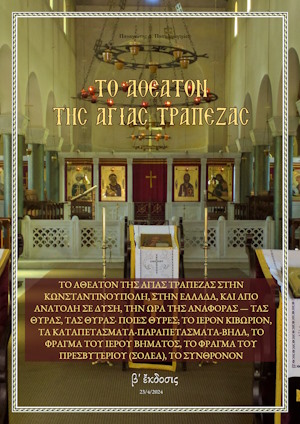
[ΠΠ10] Παν. Παπαδημητρίου, Τὸ ἀθέατον τῆς Ἁγίας Τράπεζας, στὴν Κωνσταντινούπολη, στὴν Ἑλλάδα, καὶ ἀπό Ἀνατολή σὲ Δύση, τὴν ὥρα τῆς Ἀναφορᾶς — Τὰς θύρας, τάς θύρας· Ποιὲς θύρες; Τό Ἱερόν Κιβώριον, τά Καταπετάσματα-Παραπετάσματα-Βῆλα, τὸ Φράγμα τοῦ Ἱεροῦ Βήματος, τὸ Φράγμα τοῦ Πρεσβυτερίου (Σολέα), τὸ Σύνθρονον, [PDF], β' ἔκδ. 23/4/2024 (α' ἔκδ. 5/2/2024). Στὴν ἐργασία αὐτὴ ἀναλύουμε ἐκτενῶς καὶ πολλὰ ἐπιμέρους σχετικά θέματα, π.χ.:
i. Κεφ. 5ον, Ὁ διαχωρισμὸς τῶν Φύλων στὸν Ναόν.
ii. Κεφ. 18ον, Τὸ κλείσιμο τῆς Ὡραίας Πύλης τοῦ Ἱεροῦ (τὰ Βημόθυρα καὶ τὸ Καταπέτασμα) στὴν Θεία Λειτουργία στὴν Ἐκκλησία τῆς Ἑλλάδος.
iii. Κεφ. 19ον, Τό κλείσιμο τῆς Ὡραίας Πύλης τοῦ Ἱεροῦ (τά Βημόθυρα καί τό Καταπέτασμα) στά Ἱερατικά τῆς Ἀποστολικῆς Διακονίας — Σύγκριση, σχόλια.
iv. Κεφ. 77ον, 95ον, Τὸ Καταπέτασμα στὸν Ἅγιο Συμεὼν Ἀρχιεπίσκοπο Θεσσαλονίκης (+1429).
v. κλπ.
[ΠΠ11] Παν. Παπαδημητρίου, Ἡ ἐξέλιξη τοῦ Καταπετάσματος (Τέμπλου, Εἰκονοστασίου, Φράγματος τοῦ Βήματος) [Βίντεο], 30/4/2024.
[ΠΠ12] Παν. Παπαδημητρίου, Ὅτι τό χαμηλό Τέμπλο κυρίως, καὶ ἡ ἀνοιχτή Ὡραία Πύλη, ἐμποδίζουν τόν πιστόν Λαόν νὰ προσευχηθεῖ, καὶ πόσο κακὸ κάνει στοὺς Ἱερεῖς, [PDF], αʹ ἔκδοσις (v.1.1), 31-30/5/2024.
[ΠΠ13] Παν. Παπαδημητρίου, Εὐχές τῶν Κατηχουμένων (Εὐχή διά Προσφωνήσεως, Συναπτή)· Πόσοι προσεύχονται παράλληλα καί ταυτόχρονα; Ἀναφορές Ἁγίου Ἰωάννου τοῦ Χρυσοστόμου, καί περί Προσευχῆς στήν Λειτουργία, [PDF], αʹ ἔκδοσις, 22/7/2024.
[ΠΠ14] Παν. Παπαδημητρίου, Ὁ Διάκονος τό «Δεηθῶμεν» τό λέει πρῶτα γιά τόν Ἱερέα, καί φυσικά γιά τόν Λαόν — «Τό γάρ, ∆εηθῶμεν, οὐ τοῖς Ἱερεῦσι λέγεται μόνον, ἀλλά καί τοῖς εἰς τόν Λαόν συντελοῦσιν», Ἅγιος Ἰωάννης ὁ Χρυσόστομος, [PDF], αʹ ἔκδοσις, 22/7/2024.
[ΠΠ15] Παν. Παπαδημητρίου, Ὁ Ζωοποιός Σταυρός τοῦ Χριστοῦ ἀνέκαθεν δέσποζε στό Ἱερόν Βῆμα, στήν Ἁγία Τράπεζα, καί διέλαμπε ὅταν ἦταν ἀνοιχτὴ ἡ Ὡραία Πύλη, τό Καταπέτασμα – Καί περί τοῦ Συνθρόνου, καί περί τῆς Ἐγκυκλίου γιά τόν Σταυρό καί τήν θέση τοῦ Ἐσταυρωμένου Χριστοῦ στήν Ἐκκλησία τοῦ Μητροπολίτου Περιστερίου Γρηγορίου Παπαθωμᾶ, [PDF] αʹ ἔκδοσις, 4/11/2024.
[ΠΠ16] Παν. Παπαδημητρίου, Ἡ Θεολογία τοῦ Σταυροῦ μέ τόν Ἐσταυρωμένο στήν Ἁγία Τράπεζα, [PDF], αʹ ἔκδοσις, 6/12/2024.
[ΠΠ17] Παν. Παπαδημητρίου, Ἡ Προτεσταντική «θεολογία» καί ἡ «θεολογία» τοῦ Μητρ. Περιστερίου Γρηγορίου γιά τόν Ἐσταυρωμένο, [PDF], 9/12/2024. Δημοσιεύτηκε στόν Ὀρθόδοξο Τύπο, 20/12/2024, ἀρ. φύλλου 2523, σσ. 1, 5, μέ τίτλο: “Προτεσταντικὴ ἡ «θεολογία» τοῦ Μητρ. Περιστερίου”.
[ΠΠ18] Παν. Παπαδημητρίου, Ἐπόμενοι τῶν Αἱρετικῶν, οἱ ἀφαιροῦντες τόν Ἐσταυρωμένον, [PDF], Ὀρθόδοξος Τύπος, 10/1/2025, ἀρ. φύλλου 2525, σσ. 1, 4. Ἀναλυτικός τίτλος ἄρθρου: «Ἐπόμενοι τῶν Λατίνων καί Προτεσταντῶν, οἱ ἀφαιροῦντες τόν Σταυρό καί τόν Ἐσταυρωμένο ἀπό τήν Ἁγία Τράπεζα».
[ΠΠ19] Παν. Παπαδημητρίου, Οἱ διάφοροι νεωτερισμοί στήν ἀνάγνωση τοῦ Εὐαγγελίου Οὔσης ὀψίας, τῇ Κυριακῇ τοῦ Πάσχα ἑσπέρας (Ἀγάπη), [PDF], αʹ ἔκδοσις, 22/4/2025.
[ΠΠ20] Παν. Παπαδημητρίου, Οἱ Λατινογενεῖς Νεωτερισμοί τοῦ Οἰκουμενισμοῦ καί τῆς Λειτουργικῆς Ἀναγεννήσεως στήν Θεία Λειτουργία καί Λατρεία, [PDF], 31/3/2025. Δημοσιεύτηκε στὸν Ὀρθόδοξο Τύπο μὲ τίτλο: «Οἱ λατινογενεῖς νεωτερισμοί εἰς τήν Θείαν Λειτουργίαν καί Λατρείαν», ἀρ. φύλλων 2537 - 2541, 4/4/2025 - 9/5/2025.
[ΠΠ21] Παν. Παπαδημητρίου, Αὐθεντική Λειτουργική Παράδοση (Ἀσματικό Τυπικό, Ἀρχέγονες Διατάξεις) ἢ Ἀντικουαριανισμός (Antiquarianism); [PDF], 19/5/2025. Δημοσιεύτηκε στὸν Ὀρθόδοξο Τύπο μὲ τίτλο: «Αὐθεντική Λειτουργική Παράδοση ἢ Ἀντικουαριανισμός (Antiquarianism);», ἀρ. φύλλων 2544 - 2545, 30/5/2025 - 6/6/2025.
[ΠΠ22] Παν. Παπαδημητρίου, Ὅτι ὁ Ἱερεύς ἀνέκαθεν ἐπεύχεται, ποιεῖ τήν Ἀνάγνωση τῶν Εὐχῶν πρός Ἀνατολάς - Εὐχές Γονυκλισίας Πεντηκοστῆς, Μεγάλου Ἁγιασμοῦ, Θείας Λειτουργίας, Μνημοσύνου, κλπ. [PDF], 24/6/25. Δημοσιεύτηκε στὸν Ὀρθόδοξο Τύπο μὲ τίτλο: «Ὁ Ἱερεύς ἀνέκαθεν ἐποίει τήν Ἀνάγνωσιν τῶν Εὐχῶν πρός Ἀνατολάς», ἀρ. φύλλων 2549 - 2550, 4/7/2025 - 11/7/2025.
[ΠΠ23] Παν. Παπαδημητρίου, Σύγχρονες Λειτουργίες τοῦ Ἁγίου Ἰακώβου, [PDF], 20/10/25. Δημοσιεύτηκε στὸν Ὀρθόδοξο Τύπο μὲ τίτλο: «Σύγχρονοι Λειτουργίαι τοῦ Ἁγ. Ἰακώβου», ἀρ. φύλλων 2562 - 2564, 24/10/2025 - 7/11/2025.
[ΠΠ24] Παν. Παπαδημητρίου, Νά δεχόμαστε, νά κατηχοῦμε καί νά βαπτίζουμε τούς μεταστρεφομένους στήν Ὀρθόδοξη Ἐκκλησία ἤ ὄχι; [PDF], βʹ ἔκδ., 8/1/2026. Ἡ αʹ ἔκδοση, δημοσιεύτηκε στὸν Ὀρθόδοξο Τύπο μὲ τίτλο: «Τά προβλήματα τῶν μεταστρεφομένων εἰς τήν Ὀρθοδοξίαν», ἀρ. φύλλων 2570-2571, 19/12/2025 – 26/12/2025.
[ΠΠ25] Παν. Παπαδημητρίου, Ἡ Ἀκολουθία τοῦ Μνημοσύνου πρός τήν Ἀνατολή τελεῖται [PDF], 15/2/2026. Δημοσιεύτηκε στὸν Ὀρθόδοξο Τύπο, ἀρ. φύλλων 2582 - 2585, 20/3/2026 - 10/4/2026.
Our concise liturgical articles and notes [in Greek]
(available in Ἀναλόγιον90):
1. Παν. Παπαδημητρίου, Σταματεῖστε τούς Πειραματισμούς στήν Θεία Λατρεία, στήν Θεία Λειτουργία, στό Τυπικόν, αʹ ἔκδοσις, 29/5/2024.
2. Παν. Παπαδημητρίου, Ἀπάντησις στὸν π. Δανιήλ Γ. Αεράκη, γιὰ τὸ «Οὔτε μυστικά, οὔτε ψιθυριστά, οὔτε... ἀνύπαρκτα», αʹ ἔκδοσις, 11/6/2024.
3. Παν. Παπαδημητρίου, Οι Αναφορές της Θ. Λειτουργίας του Μεγάλου Βασιλείου και του Αγίου Ιακώβου - Μία έρευνα για την κοινή τους καταγωγή (John R. K. Fenwick, OCA 240, 1992), 4/10/2025.
Our books [in Greek]
ΤΟ ΑΘΕΑΤΟΝ ΤΗΣ ΑΓΙΑΣ ΤΡΑΠΕΖΗΣ, ΣΤΗΝ ΚΩΝΣΤΑΝΤΙΝΟΥΠΟΛΗ, ΣΤΗΝ ΕΛΛΑΔΑ, ΚΑΙ ΑΠΟ ΑΝΑΤΟΛΗ ΣΕ ΔΥΣΗ, ΤΗΝ ΩΡΑ ΤΗΣ ΑΝΑΦΟΡΑΣ, Βʹ ἔκδοσις, 23/4/2024.
ΤΥΠΙΚΟΝ ΟΡΘΡΟΥ ΕΝΟΡΙΩΝ, Αʹ ἐκδοσις, Ἄθως, 2008, ISBN 978-960-6677-37-3.
ΤΥΠΙΚΟΝ ΕΝΟΡΙΩΝ Τόμος Αʹ – Ὄρθρος καθημερινῶν ἐὰν τύχει Ἅγιος μὴ ἑορταζόμενος, Γʹ ἔκδοσις, 2022, ISBN 978-618-84650-4-6.
ΤΥΠΙΚΟΝ ΕΝΟΡΙΩΝ, Τόμος Βʹ – Ὄρθρος καθημερινῶν ἐὰν τύχει Ἅγιος ἑορταζόμενος, Βʹ ἔκδοσις, 2022, ISBN 978-618-84650-1-5.
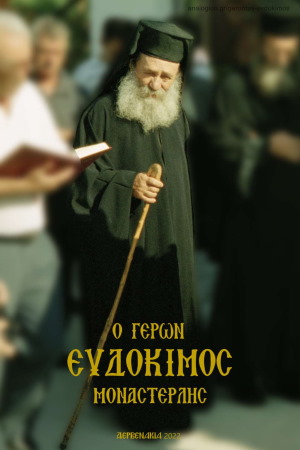
Ο ΓΕΡΩΝ ΕΥΔΟΚΙΜΟΣ ΜΟΝΑΣΤΕΡΛΗΣ, Δʹ ἔκδοσις, 2022, ISBN: 978-618-84650-2-2.
To God be the glory for all things
The article in pdf: Academia, Ἀναλόγιον